Showing posts with label brand. Show all posts

Friday, April 13, 2012

The Brand Is Not A Logo

I've known for some time that my career will be driven by connecting business and creative thinkers. This will be no simple task. If my experiences in the UO advertising and business school communities are any indication, perspectives of the "brand" and the purpose of advertising are very different depending on where you look at it. I'm extremely glad I'm able to witness the forming places of what will be future industry players' opinions on the subject. While I don't know if I will ever be a account-man-guru-phenom, I certainly can use my interactions with blooming client and agency minded people as preparation for the real deal.

In a recent presentation in a business school group I won't name, some colleagues of mine spoke about what is a brand. They suggested that a brand has a few requirements, including a logo, a tagline, and a color. This is a common (though not universal) thought in the marketing world. While it's not completely off base, I respectfully suggest that this opinion needs some guidance.


The general purpose of the brand is to allow value growth of a product line, company, etc. beyond the tangible factors of the product. It allows consumers to connect. People can't connect with products, but they can with brands because brands transcend physical limitations and adopt a persona. Brands function subconsciously as people in our minds and can be loved, detested, even worshiped. I can like a product for what it physically does, but when I like and trust what that product values, where it comes from, and what is does for me on an emotional level then I'm liking the brand encompassing it. Think of your product in a human physical form. That's your brand.

Some brands have what you could call "street cred"
I'm sorry, but a logo is not a brand, but it can tell you something about that brand. Same thing goes for a color. Tiffany's blue is not what the jeweler is, but it can tell me things about its luxury, simplicity, and tradition. You are not the clothes you wear, but the clothes you wear say something about you. Where you live gives clarity to your story just as where a product is made offers focus to the brand identity. These things are tools that contribute to brand identity, but ultimately that identity is up to the mind of the audience based on a whole slew of pieces.

Brand managers cannot control their brand in the eyes of consumers. However they can control many of the inputs that either positively or negatively influence the intended message. In marketing we refer to this as the 5 P's: product, price, placement, promotion, and people. When these line up they reinforce each other and a brand will be resilient to negative forces. When one or more factors are not consistent with the others they damage the value message of the brand and leave it vulnerable to attack.

A strong brand isn't always a beloved brand... but it helps
A common misinterpretation of the brand is that it has to do with the advertising/promotion portion of the marketing equation mostly or completely. A strong brand requires an integrated marketing approach. Without an integrated approach to the brand, the advertising is just promoting something the product is not (which really pisses customers off). To consumers a brand is not just a name, but a collection of experiences from every touch point in the product's story.

We can put a positive spin on a bad product. We can put a quality product in a cheap store. We can connect with socially conscious customers while using despicable production methods. We can even make a short-term increase in profits from these shortcuts. In the end however, it will come back to bite us. When consumers find that a brand is not what it claims to be they become hostile. When they find a brand that practices what it preaches and lines up with their values, they become customers and stay customers.

The lesson to take from all of this: when we are thinking about reinventing/creating a brand in the world, let's not fall into the trap of confusing marketing tools with their eventual effect. Let's think in terms of the brand and not just components that make it. Let's stand with conviction about our brands and support them, not just promote them. When we do this, our brands can act as influential and powerful figures in the lives of consumers, which stands better against competition, mistakes, and time. If we want profitable products, start with human brands.


Monday, November 28, 2011

22 | Loss of a Crucial Leader: Richard Lariviere

I never really paid much attention to UO President Richard Lariviere much until the shit hit the fan in the last week. He did say "howdy" to me once at a football game. And I love the man's sense of style. But after reading up, I'm truly sold on his vision for the Oregon University System (OUS). It's a vision of excellence the seven individual universities deserve.

It comes back to the idea of a brand. Brands should act as people. Currently the OUS demands that all seven institutions are the same brand and the same person, when it's obvious that they have major differences and needs. Lariviere called for the brand personas of each university to shine through and govern themselves in that light, guided by a common mission.

Politics aside, it's frustrating to watch our state government fail to relinquish any authority and fail to recognize that smaller individual brands certainly have the capability to live within larger ones. Look at every multinational in the world. Look at Proctor & Gamble, Unilever, etc. Look at the structure of the American government as defined in the Constitution. Large organizations with a narrowly focused and restricting mission ultimately fail. There doesn't exist a large enough market to justify such a specific goal applied so vastly. The mission needs to be guiding, not controlling.

Letting the universities live as individuals has significant benefits for the collective as well. For one, it mitigates risk and protects the others from the failures of one. If one university screws up - they all do - it doesn't bring down the others, because they are recognized as unique entities, not a group of conniving academic types. Negatives always outweigh positives in the public light. The OUS Board ought to remember this when deciding the fate of a public organization.

A declining institution needs bold leadership. Old ideas don't solve new problems. What the OUS really needs is top leadership as unafraid to challenge the status quo as Dr. Richard Lariviere. If not that, then an innovator such as he needs to be kept in the organization to vigilantly push the "radical" agenda, as unpopular as it may be with those in power. It's a shame that a state that prides itself on being progressive and thinking differently just ousted the figure fighting the hardest for a bold solution to the public education discussion.

Saturday, November 12, 2011

14 | Heineken's Campaign Isn't Fitting In One Bottle

This I love:
It's entertaining, distributable in several forms, gave the Asteroid Galaxy Tour a nice (and profitable) 15 minutes of fame, and overall delivers a much needed breath of fresh air from the usual barrage of beer advertising we see.

I'm guessing Heineken has some penetration troubles with the 20-something crows. The brand is old-European and trying to be fun. But it's generally percieved to be the stuff your dad drinks when he wants to feel worldly. It doesn't hold ground with the younger drinking demographic light Bud Light or Corona does. This video paints the story of Heineken so differently. The world that young adults consider dull has an underworld...and it's fun as hell! It baits the viewer to open their eyes; "Open Your World."

This, however, I don't get.
Back to boring I guess. I understand that brands, particularly larger ones, have varied audiences with different wants and needs, so a single message won't always work for everyone. But it ought to exude the personality of the brand across all messages. Most of all, it should bring value to the listener. What does this print ad bring? It's a USP faintly disguised as a semi-clever tagline. With the recent surge in micro-brew popularity (not just in Oregon too), claiming Heineken is a leader in craftsmanship isn't going to persuade anyone. To me, at least, it only dilutes an otherwise brilliant strategy.

Friday, November 4, 2011

10 | What Would Howard Hughes Do?

I read The Economist, though not as frequently as I ought to. Aside from the constant reminders that the Arab Spring is still in full bloom and that Europe is about to collapse financially yesterday, I take note of the print advertising inside. It's mostly for investment banks, information networks, top MBA programs; you know, things I can't buy. Each issue usually holds 2-3 print ads for airlines.

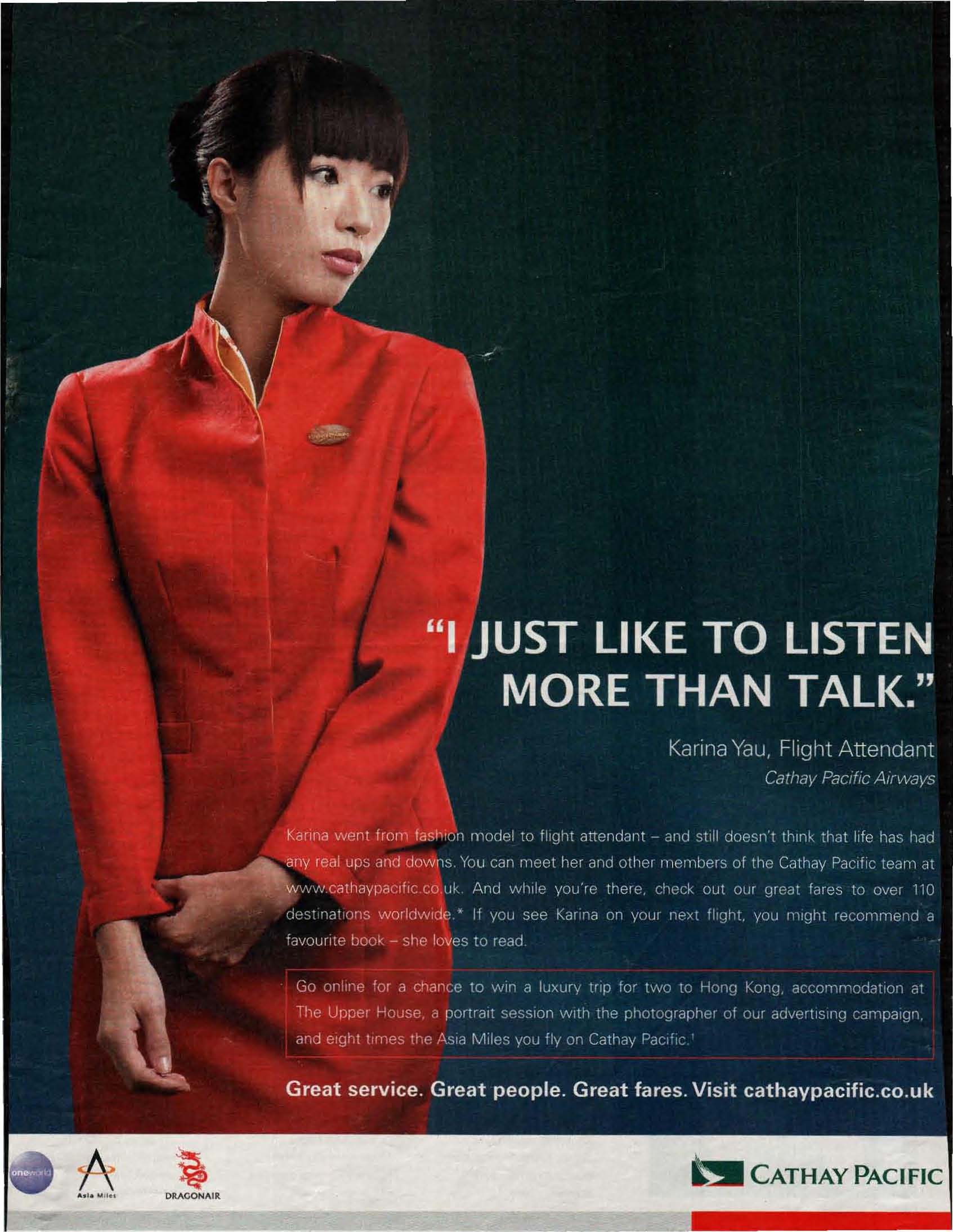
Some of them appear to take a step or two back as far as gender stereotypes go, but then I remember: this is an international magazine, with international readers, with very different cultural backgrounds. It's then that I realized that I never see advertisements for American airlines (general, not the brand itself) in The Economist. The U.S. runs a massive share of international flights in the world; it's almost bizarre that American flight carriers don't control a larger portion of business/upper class travel abroad. U.S. airlines don't even carry the stature that the international carriers do. Qatar Ailines is The world's 5-star carrier. Cathay Pacific is all about loving to serve the flyer. Emirates is about exploring the world. What do American giants stand for? This is especially peculiar considering so many of international business deals involve U.S. companies.

But then again, it does make sense. When the airline industry was deregulated in 1978 ticket prices began their long hike downhill. Dozens of new players entered the field. Operating costs initially rose now that the federal government wasn't running logistics.But then prices started falling... and never stopped until they couldn't go lower without cutting amenities. So airlines cut corners, but for the sake of profits, kept costs for customers the same. That's how we ended up with bag fees, and a la carte refreshments, and "premium" coach seats.

Every airline did the same thing, but it turned against them in the last decade. Brand parity among the American giants allowed smaller carriers to swoop in and grab the low cost/low margin/quality service position, just as the critical decision factor switched from price to quality of service. Airlines like JetBlue and Southwest Airlines are humongous yet, but they will grow to be at this rate because they made air travel a unique and enjoyable experience.

Delta, a partner to AirFrance/VTM, has caught on and is trying to brand themselves as the big guy striving to make flying suck less. But the 2011 American Customer Satisfaction Index points that Delta is the most hated airline brand in the U.S. I appreciate Delta's effort to rebrand themselves, but apparently the execution is lacking support. Nothing kills a bad product faster than great advertising (sorry W+K). Delta has a lot of growing up to do if they want to change their position at all.